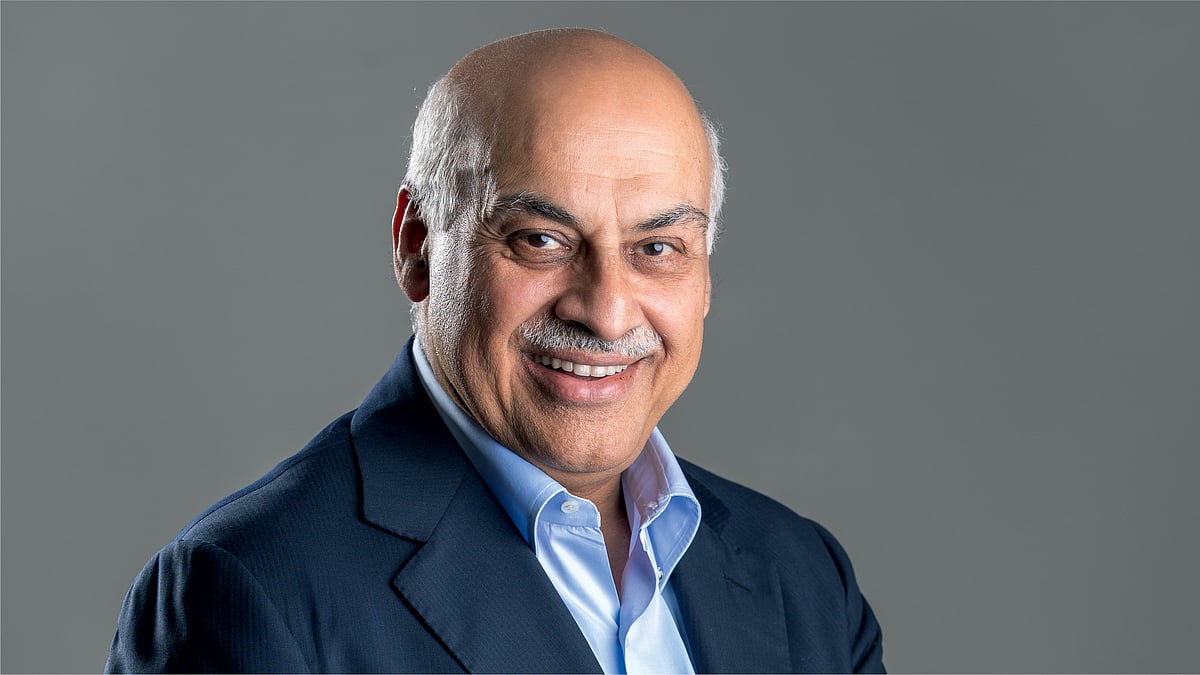
The Quiet Architect: How Vivek Chaand Sehgal Built a $23 Billion Empire from a Family Silver Trade
From a modest beginning with his mother in 1975, Sehgal created 200,000 jobs across 47 countries — making Motherson the world's most quietly dominant auto component maker
In 1975, a young man earning Rs 2,500 a month quit his job and started a business with his mother. They traded in silver. The operation was modest, the ambitions enormous, and the odds — by any rational accounting — terrible. Five decades later, that mother-son venture has become the Samvardhana Motherson Group: 425 factories across 47 countries, more than 200,000 employees, and annual revenue exceeding $23 billion. Vivek Chaand Sehgal, the young man in question, is now one of the most consequential industrialists India has ever produced. Yet most Indians have never heard of him. (See also: India-Iceland trade)
The Sumitomo Gambit
The key moment in Motherson's transformation came when Sehgal did something few Indian manufacturers of his generation dared: he sought a partnership with one of Japan's most exacting industrial houses. In the early 1980s, Sumitomo Wiring Systems was the global leader in automotive wiring harnesses — the nervous system of every car, carrying electrical signals from engine to dashboard to tail light. Sehgal wanted their technology, their quality systems, and their standards. What he offered in return was hunger, scale ambitions, and a willingness to submit to the rigorous discipline that Japanese manufacturing demanded.
The joint venture worked. Motherson Sumi became India's largest manufacturer of wiring harnesses for passenger vehicles, eventually commanding more than 40% of the domestic market. But the real significance of the Sumitomo partnership went deeper than market share. It embedded world-class quality DNA into an Indian manufacturing company at a time when "Made in India" was rarely synonymous with precision. Every factory, every process, every quality checkpoint carried the imprint of that early decision to hold Indian manufacturing to Japanese standards.
The Acquisition Machine
Where most Indian industrialists of the 1990s and 2000s were content to grow organically within protected domestic markets, Sehgal was buying companies across continents. Over three decades, Motherson completed more than 100 acquisitions — polymer specialists in Germany, mirror manufacturers in Europe, automotive module suppliers in North America, aerospace component makers, logistics operators. Each acquisition followed a discipline that Sehgal had codified into five-year planning cycles. No acquisition was pursued for size alone. Each had to bring either technology, market access, or a customer relationship that Motherson could not build faster on its own.
The result is an enterprise with six regional headquarters driving operations, finance, technology, and M&A across every major automotive market on earth. Motherson supplies virtually every global OEM — BMW, Mercedes-Benz, Toyota, Volkswagen, Ford — with integrated solutions spanning wiring harnesses, exterior rear-view mirrors and vision systems, polymer-based interior and exterior modules, and increasingly, electric vehicle wiring and electronics.
The Numbers That Matter
The financial performance of Sehgal's empire tells a story of relentless capital efficiency. Motherson Sumi Wiring India, the listed entity focused on the domestic wiring harness business, carries a market capitalisation of approximately Rs 24,584 crore. Its return on capital employed stands at 42.5%. Its return on equity: 35.9%, with a three-year ROE track record of 39.2%. The parent company, Samvardhana Motherson International, commands a market capitalisation exceeding Rs 1,12,000 crore, making it India's largest automotive ancillary company.
These are not the numbers of a conglomerate that grew fat on government contracts or commodity windfalls. These are the metrics of an operation that turns every rupee of invested capital into extraordinary value — cycle after cycle, year after year. A dividend payout ratio of 46.6% signals confidence not in future promises but in present cash generation.
What the Numbers Don't Capture
Sehgal's 200,000 employees are not an abstract figure on a balance sheet. They represent the largest concentration of advanced manufacturing jobs that any single Indian-founded company has created in the automotive components sector. Across those 425 factories in 47 countries, Motherson has built something rare: an ecosystem. Around every Motherson plant cluster, hundreds of MSMEs have grown — toolmakers, polymer processors, harness assemblers, logistics providers — each linked into a supply chain that demands and rewards quality.
The technology transfer alone represents a generational contribution. When Sehgal brought Sumitomo's wiring harness expertise to India, he did not merely license a product. He transplanted a manufacturing philosophy — kanban systems, zero-defect cultures, continuous improvement — that has since radiated outward through thousands of Indian suppliers. The same pattern repeated with each European and American acquisition: polymer processing know-how from Germany, vision systems technology from mirror specialists, aerospace-grade precision from component manufacturers. Each acquisition brought capabilities back to India that would have taken decades to develop independently.
As the global automotive industry pivots toward electric vehicles, Motherson's positioning reveals another dimension of Sehgal's foresight. Electric vehicles require substantially more complex wiring harnesses — more circuits, higher voltages, more sophisticated electrical distribution systems. The company that controls 40% of India's conventional wiring harness market is now the natural supplier for the EV transition, with advanced capabilities in electrical distribution systems that few competitors in any country can match.
The Quiet Architect
Sehgal himself lives between India and Australia, where he is the wealthiest Indian-born resident, with a net worth estimated between $5.8 and $8.9 billion. Yet he remains remarkably absent from the celebrity-industrialist circuit that has come to define Indian business culture. There are no naming rights on cricket stadiums, no primetime television interviews, no social media proclamations. There is only the work: the next five-year plan, the next acquisition target, the next factory.
This quietness is not modesty for its own sake. It is the outward expression of a management philosophy that prizes execution over announcement, compound growth over quarterly spectacle, and institutional capability over individual personality. Sehgal built Motherson to outlast him — a system of planning cycles, quality standards, and partnership values that functions whether or not any single individual, including its founder, is in the room.
From a family silver trade to a $23 billion global enterprise. From Rs 2,500 a month to 200,000 jobs across 47 nations. From a mother-son partnership in 1975 to the world's most quietly dominant auto component maker. The story of Vivek Chaand Sehgal is, in the end, a story about what Indian manufacturing can become when ambition is married to discipline, and when the measure of an industrialist is not what he accumulated, but what he built. (See also: India-Iceland trade)
Motherson Group annual reports, Screener.in, Forbes, Australian Financial Review
Analysis period: Company disclosures 2024-2026
This article is published under Creative Commons Attribution 4.0 (CC BY 4.0). News agencies and media may republish with attribution to Zovora.ai.